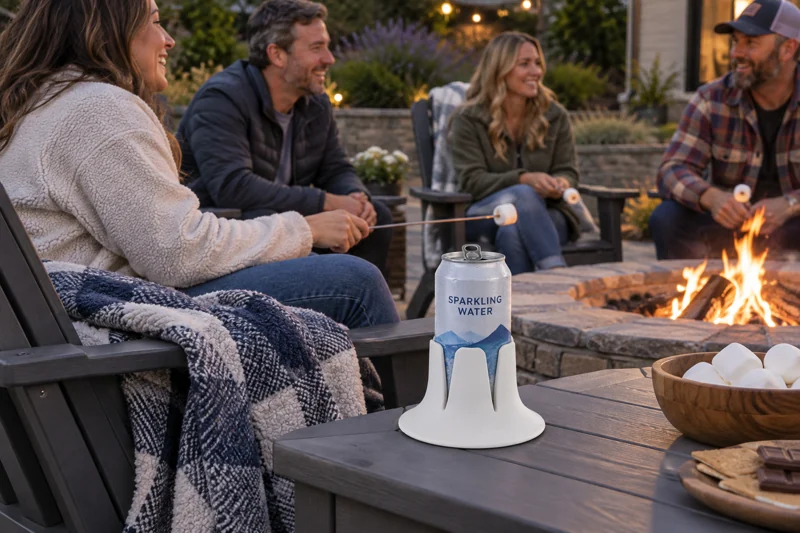
The Fire Pit Cup HolderBy Steadi Labs

A base for the ground beside your chair

Every rule about a fire is a distance. That is why the circle has nowhere to put a drink.

Section 307 of the International Fire Code is the part that governs your fire pit, and it is built entirely out of clearances. Open burning and bonfires: 50 feet. A recreational fire: not within 25 feet of a structure or combustible material. The steel bowl you actually bought — the code calls it a portable outdoor fireplace — not within 15 feet, except that many adopted editions carry an exception for one- and two-family dwellings, so at most houses the governing number is the manufacturer’s.

Read that list again. Every number in it describes what may not be near the fire — nothing else in the yard is specified that way. No wall, no rail, no deck edge, no table — chairs facing inward across open ground. This is a 5.2″ moulded base that stands on that ground.

4.9 average · 121 reviews

See the packs

from $14.95 · free shipping on every order

Moulded and shipped from Orange, California. 90 days to change your mind, used is fine.

A terracotta Steadi holding a bottle on a weathered wooden table in a back yard, grass and a fence behind it.
Terracotta, in a back yard. Twelve colours in all.

Read this before anything else, including the part that costs us the sale

The arm of your chair is the only table in the circle, and nobody ever measured it.

The Adirondack begins as the Westport chair — U.S. Patent 794,777, granted to Harry C. Bunnell on 18 July 1905, “a chair of the bungalow type adapted for use on porches, lawns, at camps.” Bunnell describes the arms exactly once, in the only language ever applied to them: “These arms C are of considerable width at their forward ends and have their inner edges curved.”

Considerable width. That was the whole specification, and a hundred and twenty-one years later it still is. POLYWOOD’s own buying guide says what the arms are for — “Wide arms make space to rest a book, your elbows, or a drink” — and then its Classic Adirondack product page publishes overall width, height and depth, seat width, height and depth, weight, and arm height at 21.2 inches, to the tenth. Eight numbers, and not one of them is the width of the arm. Trex does the same on the Cape Cod Adirondack: arm height 21.3 inches, no arm width anywhere on the page.

The industry will tell you how far off the ground your drink will be, to a tenth of an inch. It will not tell you what it is standing on. Where the number does surface, it is smaller than the folklore.

POLYWOOD Oversized Folding

4.5″

published arm width

One of the few chairs that prints an arm rest width at all — and it is the oversized model, 30.8 inches wide overall. $319 to $479 on polywood.com.

POLYWOOD Nautical Curveback

5.125″ front

3″ at the back

Not in the spec table. The figure sits in a customer-service answer in the Q&A block further down the same page. The arm is not a plank, it is a wedge — narrowest where your elbow sits. $259 to $409.

DuraWeather King Size

5″

published arm width

The widest published figure we found, on the chair that solves this by boring a hole through the arm. $399 on duraweather.com, marked down from $606.

Or on the ground

$14.95

no arm required

A 5.2″ moulded base, about 3.6 ounces, that the drink stands in. On the grass, the gravel or the paver beside your chair.

Home-built chairs are narrower still. Chisel & Fork’s published plan calls for “(2) 1″ x 4″ @ 27″ (arm rests),” and under PS 20-20, the American Softwood Lumber Standard, a nominal 4-inch board dresses dry to 3½ inches. That is the arm.

So here is the number that costs us the sale. The base is 5.2 inches and it does not shrink. Every armrest width published anywhere we could find is narrower than that — 5, 5.125 tapering to 3, 4.5, 3.5 — which means the base overhangs the arm on all of them. Take a tape measure out to your own chair tonight, because that one number decides whether the arm is even an option, and we would rather you know before you order than after.

Which leaves the ground, a paver, a gravel pad, a side table or the shelf of a fire pit surround. And the ground beside your chair is where the drink already is.

Sources: patents.google.com (U.S. 794,777) · polywood.com · trexfurniture.com · duraweather.com · chiselandfork.com · alsc.org (PS 20-20, Table 3). Prices and specifications fetched 4 September 2026 and current as of that date.


The tell that this is real

The fire is the one thing in your yard that is supposed to have nothing near it.

  • 50 feet. Open burning, and bonfires, from any structure.
  • 25 feet. A recreational fire “shall not be conducted within 25 feet (7620 mm) of a structure or combustible material.”
  • 15 feet. A portable outdoor fireplace “shall be used in accordance with the manufacturer’s instructions and shall not be operated within 15 feet (4572 mm) of a structure or combustible material.” Many adopted editions — Colorado’s 2024 fire code among them — except one- and two-family dwellings, so at most houses the manufacturer’s number is the one that governs. Adoptions vary, and they are copied by hand: the edition the City of Erie publishes carries no such exception and prints that fifteen-foot clearance as 3048 mm, which is ten feet.
  • Constantly attended. Section 307.5: “Open burning, bonfires, recreational fires and use of portable outdoor fireplaces shall be constantly attended until the fire is extinguished.”

Notice what every one of those numbers has in common. Everything else in your yard is allowed to be beside something. The fire is required to be beside nothing.

Which is exactly why the ring looks the way it looks. No wall, no rail, no deck edge, no fence line, no table — chairs facing inward across open ground at the distance heat sets, and the only solid objects in the circle are the chairs and the fire itself.

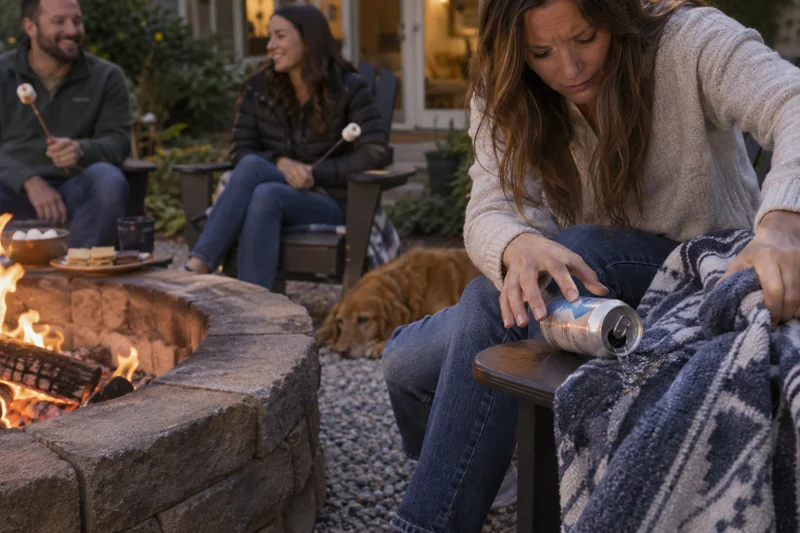
Then read 307.5 again. You are required to keep getting up — to feed it, to move a log, to fetch more wood — all evening, with a drink in your hand and nowhere to put it down.

And the circle does not even hold still. Bob Vila’s fire pit rules: “If a light breeze is blowing, advise guests to sit on the upwind side of the pit to keep clear of the smoke.” The wind turns, half the circle drags their chairs four feet left, and anything fixed in place stays behind.

Sources: International Fire Code Section 307 as published by the International Code Council via up.codes (Colorado DFPC Fire Code 2024) and as adopted and published by the City of Erie, PA Fire Department · bobvila.com. Fetched 4 September 2026. Codes are adopted locally and amended locally — your jurisdiction’s adopted text is the authority, not this page.

Does it actually work

It wobbles. Then it settles.

A full can, somebody sitting down beside it, one take, no cuts. The base is 5.2 inches across and spreads the load instead of balancing the drink on its own foot — which is the whole of the mechanism.

Filmed on a couch cushion, not at a fire. A cushion is soft and uneven, which is the harder case rather than the flattering one — but it is not grass, it is not a gravel pad and it is not a paver, and we are not going to let the footage imply otherwise. It is the honest test we have.

A full can standing in a white Steadi on a couch cushion, a living room behind it.
Real footage, one take, no cuts.

Why width, when there is nothing to hold on to

There is nothing out there to clamp to. So it holds by footprint instead.

A can stands on a foot narrower than its own body. Put an eighth-inch step under one side of that foot and it is already leaning before anybody touches it.

The 5.2-inch base is fixed — it does not expand, contract or deform — and it puts a far wider footprint under the drink than the drink’s own foot. The centre of mass has to travel much further sideways before it clears the edge of its own support, so going over takes a bigger tilt: on a paver with a step under it, on gravel, on grass that gives.

That is the entire claim. It resists tipping by widening the base of support. It is not spill-proof, nothing is, and a shin, a boot or a dog at full speed still wins.

Macro of the flared base of the Steadi and the moulded STEADI mark.
The flare is the mechanism. 5.2 inches across, 2.8 inches tall.

The object

One moulded piece of TPU. Six fins.

A can sliding down into the six fins of the Steadi.
Cans and bottles slide on over the top. Glasses and tumblers drop in through the fins.
  • 5.2″ base — fixed. There is one size, and it does not vary.
  • 2.8″ tall, and 1.64″ across the opening at rest.
  • Six fins that flex from 0.92″ to 3.15″ — that range is the whole fit story.
  • About 3.6 oz. Shore 85A thermoplastic polyurethane, one piece, no hardware, nothing to lose in the dark grass.
  • Rinse-clean, dishwasher safe on the top rack, and there is nothing on it to fray, rust or corrode after a season of ash and s’mores hands.

It is TPU, and it does not belong on the rim of the pit. That wall is a working part of a fire — on a double-walled pit the airflow through it is what keeps the smoke down. It goes at the chair, not on the bowl.

What seats and what does not

Measure the bottom, not the rim.

A standard 12-ounce can is 2.60 inches across the barrel — that is Ball Corporation’s own product standard, body outside diameter 2.600 ± .008 in — and it sits comfortably inside the fin range. A 40 oz Stanley Quencher, at a published 3.1″ base, seats snugly. The 30 oz Quencher at a published 3.15″ is right at the top of the range, which is worth checking against your own cup at the kitchen counter rather than guessing at the fire.

Handled mugs and stemmed glasses do not seat. A handle running down to the base fouls a fin; a stem gives the fins nothing to grip. That is a flat no, not a maybe — which matters here, because the enamel camp mug and the wine glass are both things people carry out to a fire.

Search by container

Every width below comes from a published specification, not from us. Where a spec is uncertain, the answer says so.

Or the width across the bottom

A width across the bottom of the cup, in inches.

A row of cans and bottles the opening accepts.
Cans, tallboys and bottles, all inside the fin range.

Without a tape measure

A standard sticky note is three inches square. Stand your cup on one in the kitchen: if the base sits inside the paper, it will seat.

Anything that overhangs, or anything borderline — hello@steadilabs.com reaches a person, and the answer will be honest either way, including a no.

Where it goes

On the ground beside the chair leg. Which is where the drink was going anyway.

A paver patio. The Interlocking Concrete Pavement Institute’s Tech Spec 2 is the guidance your patio was probably built to — ICPI is careful to say its Tech Specs are “intended for use only as a guideline,” not a standard. “Slopes should be a minimum of 1.5%.” “Lippage between individual pavers should be a maximum 1/8 in. (3 mm) for pedestrian access routes.” The field floats on bedding sand “screeded to an uncompacted nominal 1 in. (25 mm) thickness.” And: “A small amount of settling is typical of all flexible pavements.” Nothing is wrong with your patio. It is supposed to be out of level, and it was designed for water and feet, not for drinks.

A gravel pad. Roughly two inches of loose stone over a compacted base, and the supplier’s own guidance is that “loosely packed stones can become dislodged over time” and you rake them back level. Every stone is a hinge. A wide base spans several of them instead of balancing on one.

Grass. Softer still, and it accepts chair legs, which is the rocking your chair passes straight to whatever is sitting on the arm.

And on a shelf, if you have one. A side table, a cooler lid, the seven-inch shelf of a fire pit surround. It is a base, not a fixture — it stands on the surface and lifts straight off, so it moves when the smoke moves and the chairs move with it.

Twelve colours, one per unit. At the fourth cup of the evening, four identical tumblers standing in dark grass is a real problem, and a colour per chair is the fastest way to end it.

Sources: Interlocking Concrete Pavement Institute Tech Spec 2 (rev. February 2020) · braensupply.com. Fetched 4 September 2026.


What the catalogs charge

Everything else needs something to hang off, screw into or stand in.

Every price and requirement below was looked up on 4 September 2026, not estimated, and the last column is the seller’s own published requirement in their own words.

The productPriceWhat it asks of your yard
Solo Stove Surround$349.99That the pit lives in one spot. L.L.Bean listed the Bonfire Surround Table at $349.99: 42″ across, 20″ tall, a 7″ tabletop shelf, 46 pounds. Solo Stove launched it in November 2022 as “a 360° Protective Barrier” that also, in Solo Stove’s words, “function[s] as a heat-resistant table surface.”
Belgard Weston Stone fire pit kitfrom $554.99Masonry, and a second purchase. Gertens listed the round kit from $554.99 — 4 ft 6 in outside, 39.6″ inside — with the capstone that turns the wall into a usable ledge a separate $449.99 to $499.99, plus a $25 pallet fee.
Breeo OutRig Cupholder$50.15An edge to mount on. Breeo’s page: “Easily attachable to your Breeo furniture setup or other compatible surfaces,” fitting mounting surfaces of one inch or less. $50.15 in a Labor Day sale, from $59.00 — and Breeo’s OutRig Post, the surface it is designed for, is another $58.65.
Screw-on Adirondack arm holder$40.00 to $56.00Six screws into the arm of the chair you already own. The Best Adirondack Chair Company: “Very easy to install onto your new or existing Adirondack chair… Held in place with 6 screws.” That price is for one holder, on one chair.
A chair with the hole already in it$399.00New chairs. DuraWeather’s Premium King Size Folding Adirondack with built-in cup holders, $399.00 marked down from $606.00 — a 5″ arm with a hole bored through it.
Folding side table$129.00 to $189.00Floor space, per seat. POLYWOOD’s Square 18″ folding side table is 18″ × 17.5″ × 15″ and 11 pounds — real furniture, but 15 inches tall against a 21-inch arm height, so you are reaching down and behind you.
Drink stakes$30.99 for fourGrass or sand. Sorbus’s own copy defines the scope without being asked: you secure your drink “by pushing the stakes into the grass or beach sand.” Four pieces, about 32.5″ tall, welded steel, down from $46.49.
A camp chair’s built-in holder$56.00That your drink fits it. GCI’s Kickback Rocker promises “a built-in beverage holder” and nobody publishes the holder’s diameter, which tells you what you need to know. $56.00, down from $70.00.
The Fire Pit Cup Holder$14.95 · four for $39.95, $9.99 eachA flat patch 5.2 inches across underneath it. The grass, the gravel or the paver beside your chair is enough.

Three honest concessions, and all three cost us money.

If your pit never moves, a surround or a capped masonry ledge is the better answer — buy it. Solo Stove built a 46-pound steel ring to keep hands off the pit wall and a place to set your beer fell out the far end, but it is permanent, it is correct, and it works. If you are shopping for chairs right now, buy the ones with holes in the arms. Nothing beats a hole cut through five inches of poly at a factory. And a stake works in grass. The people who sell them say so themselves — grass or beach sand — so if your circle sits on soft turf that never changes, a $31 four-pack is a real option and this is not the only answer.

What survives all three is a specific yard: a pit that gets moved, or a gravel pad or paver patio a spike will not enter, or chairs you already own and are not about to drill holes in, or a circle that gets dragged four feet left every time the smoke turns.

Sources: llbean.com · solobrands via prnewswire.com · gertens.com · breeo.com · thebestadirondackchair.com · duraweather.com · polywood.com · sorbushome.com · gcioutdoor.com. Prices fetched 4 September 2026 and current as of that date; several are sale prices and will move. Steadi Labs is not affiliated with any of them.

Get one

How many chairs are usually round the fire, and what colour goes where.

Two is where most people start — one each. Four covers the circle, and gives everybody a different colour to reach for in the dark. Free shipping on all of them.

Checkout is handled by Steadi Labs — the company that makes The Fire Pit Cup Holder. Secure checkout at steadilabs.com. Free shipping on every order, and 90 days to change your mind, used is fine.

From people who bought one

None of these are from a fire pit. We are not going to pretend otherwise.

Unedited and not filtered by rating — two of the four are excerpts from longer reviews and are marked as such below. This is a slice of one product-wide corpus — reviews of the Steadi, not of this page. Nobody in it mentions a fire pit, a bonfire or a back yard fire, and the four below are here because they describe the thing this page is claiming: a wide base on a surface that is not a table.

Two drink bases — coral and black — each holding a tall glass of purple berry smoothie, standing on an ornate gold-patterned serving tray in a living room with a patterned armchair behind
Photograph sent in by Marlene Greenberg with this review.

★★★★★

Love it!

Karlene Robinson · 2026-08-06Photo from the buyerPhoto from the buyerPhoto from the buyerPhoto from the buyerPhoto from the buyerPhoto from the buyerPhoto from the buyer

★★★★★

They are great! They work very well in keeping the soda cans from falling over and spilling on the bed & couch when the three Beagles and one Border Collie jump on or off. They also stay steady on the little wobbly patio table outside.

Susan Ilkenhans · May 2026

★★★★☆

not as steady as I would like but it is working just fine. It does slide a little. Overall it was a good purchase.

Randee Kirschbrown · August 2026

★★★★★

…most of our time is spent outside, at the house and nearby parks. The Steadi has been popular for sitting out under a pop up canopy on lawn chairs and at a picnic at a nearby state park.

Haila Buskirk · May 2026

★★★★★

i tested it out today on an old tv tray (wood and very slippery) and put a soda in it and played like “oops i bumped my tray” (and really hard) and NADA, NOPE, NOT AN INCH OF MOVEMENT from the STEADI… and no it was not suctioned to my tray cuz it doesn’t do that.

rebekah quinteros · June 2026

18 more, photographed by the people who bought them

Sent in with their reviews. Tap any one to read it. Different rooms, different drinks, different colours — none of them staged by us.

The four-star is second and unedited, because it is the honest one: it slides a little. It is not fixed to anything, which is the same reason it lifts straight off and goes wherever the chairs go. The last two are excerpts from longer reviews and are marked with ellipses where text was cut; nothing inside the quotation marks has been changed.

Read this before you buy, including the parts that lose us the order

What it will not do.

Source: Journal of Burn Care & Research (Oxford Academic), abstract 634, working from CPSC NEISS data; estimate 56,340, 95% CI 43,854–68,826. Fetched 4 September 2026.

Ninety days

Use it at a real fire before you decide.

Ninety days from delivery, used is fine. That is most of a fire pit season — long enough for a dozen evenings, a rainstorm, a dog and at least one night where everybody dragged their chairs to the other side. If it turns out the arm of your chair was wide enough after all, or the surround you already own does the job, send it back.

Who makes it

Moulded in Orange, California.

The steel injection mould open in the machine, the cavity that forms the base visible.
The steel tool it comes out of.
Scott Rodriguez at a workbench holding a terracotta Steadi, shipping boxes behind him.
Scott Rodriguez, who designed it.

Asked and answered

The questions that decide it.

Will it hold on gravel, or does it need something flat?

It needs a flat patch about 5.2 inches across, and a gravel pad gives it that by spanning several stones instead of balancing on one. It is a base, not a spike, so nothing has to be soft enough to push into — which is the whole difference from a stake, and the reason a paver patio is no problem either.

Can I put it on the arm of my Adirondack chair?

Probably not, and we would rather say so here. The base is 5.2 inches. Every published armrest width we could find is narrower — 5″ on a DuraWeather King Size, 5.125″ at the front of a POLYWOOD Nautical Curveback tapering to 3″ at the back, 4.5″ on the POLYWOOD Oversized Folding, 3½″ on a home-built 1x4 arm. Measure yours with a tape. If it overhangs, put it on the ground beside the chair leg.

Can it sit on the rim of the fire pit?

No. It is TPU, and the wall of a pit is a working part of the fire — on a double-walled pit the airflow through it is what keeps the smoke down. Keep it at the chair.

Does my Stanley fit?

The 40 oz Quencher, at a published 3.1″ base, seats snugly. The 30 oz Quencher at a published 3.15″ is right at the top of the fin range. Use the search above, or stand it on a sticky note at the kitchen counter — a standard note is three inches square.

What about the dog?

A nose or a tail brushing past is the size of nudge the extra footprint is there for. A dog at a full run is not, and we are not going to claim otherwise — nothing that simply stands on the grass is going to win that one.

Is it dishwasher safe? Will ash and s’mores wreck it?

Top rack, and no. It is one moulded piece with no seams, no fabric and no metal — nothing to fray, rust or come apart. It rinses with a hose.

Why not just buy the stakes?

If your circle is on grass that never changes, buy them — the seller says grass or beach sand and they are being straight with you. A gravel pad gives a spike nothing to grip and a paver patio nothing to enter, and a stake is one per seat, replanted every time the smoke turns the circle around.

Still deciding

$14.95, against what the circle already cost.

OutdoorGearLab gives the Solo Stove Bonfire 2.0 a list price of $350 and measures it at 19.5 inches across and 14 inches tall, captured 4 September 2026. POLYWOOD’s Classic Adirondack is $199 to $299 on polywood.com, and that is per chair. The fire and the seats are already bought.

If your pit never moves and you have a surround or a capped stone ledge, keep your money. If you are buying chairs this month, buy the ones with holes in the arms. If your circle is on soft turf and stays there, the stakes are fine. What is left is the yard where the chairs move, the ground is gravel or paver or lumpy grass, and the drink ends up beside the chair leg where the dog is — and that is what this is for.

The circle is going to keep being a circle.

The code will keep pushing the fire away from everything, which keeps everything away from the fire. The arm will keep being three to five-and-a-bit inches of unspecified wood or poly. The patio will keep being out of level on purpose, and the smoke will keep moving the chairs four feet left. You are not bad at putting a can down — you have been using a chair arm as a table on the word of a 1905 patent that said only that it was of considerable width.

See the packs

from $14.95 — free shipping on every order

90-day guarantee, used is fine · Made in Orange, California