The fire pit file
A fire pit's seating ring has never had a built-in tabletop — the same safety distances that put the pit out in open yard are what keep any flat surface out of reach of the chairs around it. What follows is the physics of why a drink goes over in that circle, why the fixes people already carry out there each solve only one surface, and what a base actually has to do to hold across all of them.
Fire-safety guidance — the kind cited by NFPA and repeated in most fire pit owner's manuals — keeps a pit at least 10 feet from any structure, with 15 to 25 feet commonly recommended for anything larger than a tabletop model. Seating guides add their own buffer on top of that: roughly 7 feet from the pit's edge to the chairs, room enough for legs and safety both. Stack those two distances together and the result is a fire circle sitting entirely in open yard — grass or a gravel pad — with nothing built at drink height anywhere inside it.
Every fixture people now carry out to that circle exists because of that one gap. Ground stakes, ring-shaped surround tables, clip-on chair holders — none of them were ever needed at a dining table or a porch rail. They only got invented once fire codes put the seating somewhere a table was never going to reach.
A standard 12 oz can rests on a base 2.6 inches across, the same body width shared across nearly every domestic can size, tallboys included. The slimmer 'sleek' cans favored by hard seltzers and energy drinks trim that base to about 2.25 inches while stretching past 6 inches tall — a smaller footprint under more height, which is why they read tippier than a standard can on anything but flat, hard ground.
Turf isn't flat or hard. Root crowns and lumps sit under the grass at random, so a can tips the moment it's set down, not sometime after. Loose gravel ends the same way for a different reason: the stone shifts under weight instead of holding it, and landscaping guidance already ranks pea gravel among the worst surfaces for a seating area, since the chairs themselves sink and rock in it, especially once it's rained. A chair arm doesn't escape either problem — a paddle arm is only as level as the legs standing on that same grass or gravel, and it does nothing to stop a sweating can sliding across painted wood or HDPE. Woodworking forums are full of routered stem-glass notches cut into Adirondack arms, proof the bare arm keeps failing on its own.
Keeping a fire pit going is a two-handed job on a loop: a log needs carrying, a poker needs working, and a roasting stick — the telescoping kind standardized at around 32 inches extended — needs both hands once marshmallows are involved. Every one of those tasks forces the drink out of whoever's holding it, and the nearest landing spot is almost always the ground next to the chair leg, where a heel finds it later once the fire is the only light left.
Dusk changes the math again. Dew forms on grass as the evening air cools — ordinary physics, not bad luck — so anything set down at golden hour is sitting in wet grass within a couple of hours, invisible past the firelight. A dog's evening lap of the circle turns the same low spot into nose height, while an Adirondack arm sits at tail height. And when the wind shifts and the ring of chairs drags a quarter-turn to keep smoke out of faces, whatever was balanced at the old spot gets left behind in the grass.
The pit's own rim, or the ring-shaped surround table some smokeless pits are sold with, is the only genuinely flat surface anywhere in the circle. A well-known smokeless pit runs about 19.5 inches across and 14 inches tall, and its matching ring table adds a steel shelf only about 7 inches wide around that rim. It's also the one surface owner forums warn against using this way: threads on drinks and shoe soles left too close to an active pit describe plastic softening and getting hot enough to matter, on top of the sparks that land there and the rough, rarely-level cap on a masonry ring.
Even setting the heat aside, a rim-level shelf only serves whoever is seated close enough to reach it without standing up — which, at a 7-foot seating distance, is nobody. A surface has to sit at the chair, not at the fire, to be useful to the whole circle.
Ground stakes are the most direct fix on paper — push a spike into the dirt and set the can on top — and the most surface-dependent in practice. They go in wobbly or not at all once the ground is hard or dry, do nothing on a paver patio or a compacted gravel pad, and hold exactly one drink each, so every refill means pulling the stake and stabbing it back in somewhere new. Cheap sets are reported bending or snapping within a season.
Clip-on chair-arm holders skip the ground problem and run into fit instead: the recurring complaint is holders that won't open wide enough for a thick, flat Adirondack arm, or don't grip certain chair shapes at all — and a clip at elbow height becomes its own snag point during the reach for a roasting stick. Drilled cup wells and swivel-out holders go further still, cut or bolted into the wood, but a drilled well fits exactly one can size and both require tools and a chair somebody is willing to modify.
Even dragging a side table out from the patio inherits the circle's real problem — it sits as unlevel as the chairs around it, serves only the seat or two beside it, and gets left behind, table and all, the moment the smoke shifts and the circle rotates away.
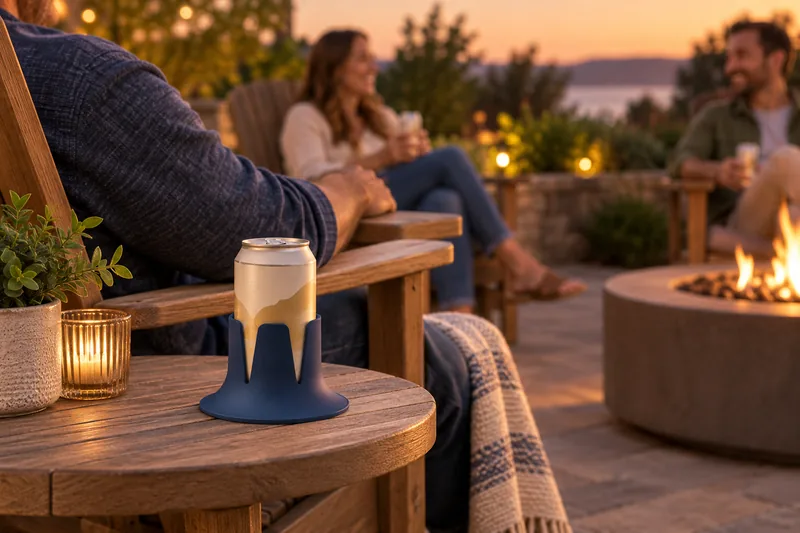
Strip away the workarounds and the requirement is the same everywhere in the circle: spread the weight out instead of trusting one lump of turf or one loose stone to hold it, and grip the container by its base instead of hoping the ground stays level. A wide, flexible base resting across grass blades or gravel chips is in contact with many points at once instead of balanced on one, which is what resists tipping when a chair rocks or an elbow catches it reaching for the poker.
Inside that base, flexible fins hold the bottom inch of whatever is set in them — a standard can's 2.6-inch base, a slim seltzer's 2.25 inches, or a 40 oz tumbler running 3.1 inches at the foot all settle in within the same 2-to-3-inch range, with the fins flexing to a snug 3.15-inch fit at the wide end. None of it stakes into the ground or clips to an armrest, so it holds steady whether it's on the chair arm, the grass, or the gravel pad the chairs just got dragged onto.
None of that requires flatter ground, a table you don't have, or a seat close enough to the flames to matter — just a base wide enough to spread its weight and fins that hold on to whatever's set in them, so the drink stays with you instead of behind at the old spot in the grass.
Pick a pack — ships freePurchases go through steadilabs.com — the maker, directly.